

Winning the OODA Loop: Processing High-Velocity Data in Contested Environments
Winning the OODA Loop: Processing High-Velocity Data in Contested Environments
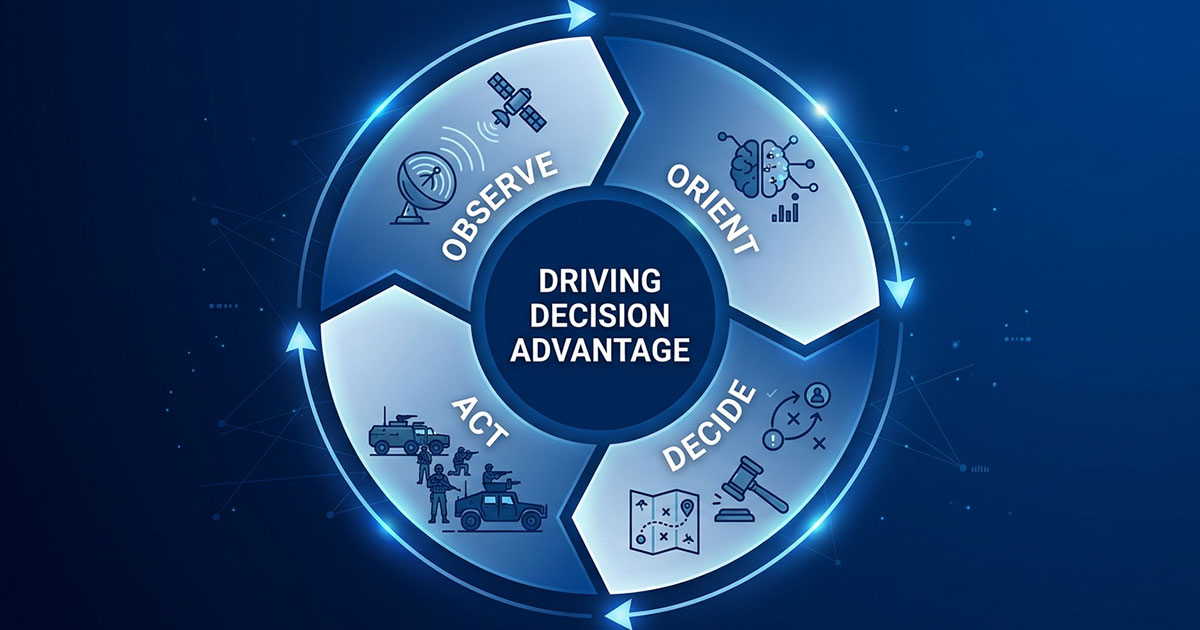
In modern conflict, the advantage no longer belongs solely to the side with the most sensors or the largest data stores—it belongs to the side that can process, decide, and act faster than its adversary. This is the essence of OODA loop (Observe, Orient, Decide, Act), originally articulated by John Boyd. In a contested environment—where communications are degraded, infrastructure is targeted, and deception is pervasive—maintaining decision superiority depends on aggressively eliminating latency at every stage of the data lifecycle.
This article explores the core challenges of high-velocity data processing in such environments and outlines architectural and operational strategies to compress latency and keep decision-makers inside the adversary’s OODA loop. As our founder Dave Sappington was known to say in virtually every conversation, “speed, Speed, SPEED” is the imperative, most of all when it comes to intelligence information processing.
The Nature of the Problem: Velocity Under Fire
High-velocity data environments are defined by three compounding factors:
1. Sensor Proliferation
ISR platforms—space, air, maritime, cyber—generate continuous streams of data at increasing resolution and frequency.
2. Contested Infrastructure
Adversaries actively degrade networks through jamming, cyber intrusion, and kinetic disruption.
3. Decision Urgency
Tactical windows shrink. The value of information decays rapidly—often within seconds.
The result is a paradox: more data than ever, but less time and fewer reliable pathways to turn it into actionable insight.
Latency: The True Adversary
Latency is not a single bottleneck—it is cumulative. It exists across multiple layers:
- Collection latency – delay between sensing and availability
- Transport latency – delay in moving data across networks
- Processing latency – time required to analyze and fuse data
- Human latency – time for interpretation and decision-making
- Action latency – delay in executing decisions
In contested environments, each one grows unless it is intentionally constrained.
Key Challenges in Reducing Latency
1. Fragile Data Transport
Traditional architectures rely heavily on centralized processing—data is collected at the edge and transmitted back to core data centers. In contested environments:
- SATCOM may be degraded or denied
- Line-of-sight links are intermittent
- Bandwidth is constrained and contested
Impact: Transport latency becomes the dominant factor, often rendering downstream processing irrelevant.
2. Centralized Processing Bottlenecks
Cloud or enterprise data centers introduce:
- Queueing delays under load
- Dependency on stable connectivity
- Inability to prioritize time-critical data effectively
Impact: Even if data arrives, it may be too late to matter.
3. Data Overload and Signal-to-Noise Collapse
High-volume data streams include:
- Redundant observations
- Deceptive or spoofed inputs
- Irrelevant or low-confidence detections
Impact: Processing pipelines waste cycles on low-value data, increasing latency for critical insights.
4. Cross-Domain Fusion Complexity
Modern operations require fusion across:
- Multi-INT (SIGINT, GEOINT, OSINT, MASINT)
- Multiple spatial domains
- Multiple classification domains
- Multiple service equities
- Coalition partners with varying standards
Impact: Data translation, validation, and correlation introduce friction and delay.
5. Human-in-the-Loop Constraints
Even with automation:
- Analysts must validate outputs
- Commanders must interpret and trust recommendations
Impact: Cognitive overload and interface inefficiencies slow the “Decide” phase of the OODA loop.
Design Imperative: Latency Elimination as a System Property
To stay inside an adversary’s OODA loop, latency reduction must be treated as a first-order design constraint—not an optimization after the fact.
1. Push Compute to the Edge
Principle: Process data as close to the sensor as possible.
- Deploy AI/ML models on airborne platforms, vehicles, and forward nodes
- Perform initial filtering, classification, and prioritization locally
- Transmit only decision-relevant data, not raw streams
Outcome: Eliminates transport latency for first-order insights.
2. Prioritize Data, Not Traffic
Principle: Not all data is equal—treat it accordingly.
- Implement mission-aware data tagging
- Use adaptive routing based on urgency and confidence
- Drop or defer low-value data under constrained bandwidth
Outcome: Ensures critical information moves first, reducing effective latency.
3. Architect for Intermittent Connectivity
Principle: Assume the network will fail.
- Use store-and-forward mechanisms
- Enable local autonomy when disconnected
- Synchronize state when connectivity resumes
Outcome: Maintains operational continuity without waiting for the network.
4. Stream Processing Over Batch Processing
Principle: Act on data in motion.
- Use real-time pipelines instead of periodic aggregation
- Apply incremental fusion and continuous updating
- Avoid “wait until complete” paradigms
Outcome: Decisions are made on current data, not historical snapshots.
5. Reduce Human Latency Through Augmentation
Principle: Accelerate—not replace—human decision-making.
- Provide confidence-scored recommendations
- Use intuitive visualizations aligned to mission context
- Pre-compute likely courses of action
Outcome: Compresses the “Orient” and “Decide” phases without sacrificing trust.
6. Standardize for Rapid Fusion
Principle: Eliminate translation overhead.
- Adopt common data models (e.g., OGC, UCI-like schemas)
- Enforce metadata consistency at ingestion
- Use schema-on-read approaches where necessary
Outcome: Reduces friction in cross-domain and coalition data integration.
The Shift: From Data-Centric to Decision-Centric Architectures
Legacy systems are designed to collect and store data. Modern contested operations require systems designed to enable decisions.
This shift demands:
- Event-driven architectures instead of repository-centric designs
- Data Recency (diminishing value of data over time)
- Closed-loop feedback between sensing, processing, and action
The system must continuously answer: What does the decision-maker need right now to act faster than the adversary?
Staying Inside the OODA Loop
To “get inside” an adversary’s OODA loop is not a one-time achievement—it is a sustained condition. It requires:
- Faster observation through distributed sensing
- Faster orientation through automated fusion
- Faster decisions through augmented cognition
- Faster action through integrated C2 systems
Every millisecond saved compounds across the loop.
Conversely, every millisecond lost—whether in transmission, processing, or interpretation—gives the adversary space to react.
Optix: Engineering for Decision Velocity in Contested Environments
To address these challenges, GA-Intelligence has developed the Optix platform, which is engineered from the ground up to compress latency across the entire data-to-decision chain. Rather than treating data processing as a back-end function, Optix is architected as a decision-centric, distributed system designed to preserve tempo under degraded, denied, and deceptive conditions.
What follows is how Optix operationalizes each of the latency-reduction imperatives.
1. Tactical Edge Processing: Analytics Where Decisions Happen
Traditional systems centralize all processing at distant data centers; Optix brings analytics forward to where operators work.
How Optix does it:
- Deploys modular "skills"—containerized analytic functions—directly to tactical edge environments (forward operating bases, ground control stations, shipboard command centers)
- Executes inference and analysis (e.g., detection, classification, track initiation) in resource-constrained field environments
- Supports flexible deployment across available hardware (standard laptops, ruggedized workstations, edge servers—CPU or GPU)
Result:
- Operators see analyzed intelligence at the point of action, not hours later at headquarters
- Only mission-critical insights and alerts flow back to enterprise systems
- Analytics run even in denied, degraded, or disconnected network conditions
Impact:
Eliminates round-trip delays to centralized systems. Analysts in the field make faster, more informed decisions with local processing—no need to wait for data to travel hundreds or thousands of miles for analysis.
2. Skill-Based Architecture: Composable, Mission-Adaptive Processing
Optix replaces monolithic pipelines with a skill-based architecture, where each analytic function is independently deployable and orchestrated.
Key characteristics:
- Skills can be dynamically loaded, updated, or removed without system downtime
- Mission-specific pipelines are assembled on demand, not preconfigured
- Skills operate on shared data fabrics, enabling reuse and chaining
Example:
A SIGINT detection skill triggers a GEOINT cueing skill, which then invokes a tracking and intent inference skill—all within a continuous, streaming context.
Latency Impact: Eliminates rigid processing sequences and reduces orchestration overhead, enabling near-instant chaining of analytics.
For another example of this capability in action, view our Autonomous Tasking with TacACE and Optix.C2 Showcase Maturity and Operational Readiness demonstration in collaboration with GA-ASI.
3. Data Triage and Prioritization: Bandwidth as a Weapon System
In contested environments, bandwidth must be treated as a constrained, high-value resource.
How Optix manages this:
- Applies confidence scoring and mission relevance tagging at the edge
- Implements adaptive publish/subscribe (pub/sub) mechanisms
- Supports selective dissemination, where only subscribed consumers receive specific data types
Outcome:
- Critical alerts propagate immediately
- Lower-priority data is deferred, compressed, or discarded
Latency Impact: Reduces congestion and ensures that the most important data arrives first.
4. Resilient, Distributed Data Fabric
Optix is designed to operate across disconnected, intermittent, and low-bandwidth (DIL) environments.
Core capabilities:
- Federated data architecture—no single point of failure
- Store-and-forward synchronization across nodes
- Local autonomy, allowing edge nodes to continue operating independently when disconnected
Key concept:
Each node maintains a local, authoritative view of the operational picture, which is reconciled with others when connectivity permits.
Latency Impact: Eliminates dependency on continuous connectivity and prevents decision stalls due to network disruption.
5. Real-Time Streaming and Incremental Fusion
Optix is built around stream processing, not batch analytics.
How it works:
- Data is processed as it arrives, not after accumulation
- Fusion occurs incrementally—tracks, identities, and patterns are continuously updated
- Supports temporal reasoning, accounting for data age and relevance
Example:
A track is not “rebuilt” every cycle—it is continuously refined as new observations arrive from multiple sources.
Latency Impact: Removes batch delays and ensures the operational picture is always current.
6. Cross-Domain and Multi-INT Fusion Without Friction
Optix addresses one of the largest sources of latency: data translation and integration.
Approach:
- Uses common data models and ontologies aligned to open standards (e.g., OGC, UCI-like schemas)
- Embeds metadata normalization at ingestion
- Enables schema-on-read for flexible integration of new data sources
Coalition-ready:
- Supports multi-level security (MLS) patterns
- Enables controlled data sharing across partners without duplicative pipelines
Latency Impact: Eliminates time-consuming data transformation steps and accelerates fusion across domains.
7. Human-Machine Teaming: Compressing Cognitive Latency
Optix is not just a data platform—it is a decision support system.
Capabilities:
- Presents contextualized insights, not raw data
- Provides confidence scores and provenance for all analytic outputs
- Enables course-of-action (COA) recommendations based on fused data
User experience:
- Interfaces are aligned to mission workflows (e.g., air defense, maritime surveillance)
- Supports alert-driven operations, reducing the need for constant monitoring
Latency Impact: Reduces the time required for analysts and commanders to interpret and act.
8. Closed-Loop Feedback: Learning at Operational Tempo
Optix engineering teams are constantly evolving the platform to incorporate more continuous feedback loops between sensing, processing, and action.
Mechanisms:
- Analyst inputs and decisions are fed back into the system
- Models and rules can be adapted in near real time
- Supports active learning to improve detection and classification over time
Outcome:
- The system becomes more accurate and faster as it operates
- Reduces repeated analysis of known patterns
Latency Impact: Decreases future processing time and improves decision confidence.
9. Interoperability with C2 Systems: From Insight to Action
Generating insight is insufficient if it cannot be acted upon immediately.
Optix integrates with:
- Command and control systems via standard interfaces (e.g., UCI, REST, message buses)
- Tactical data links and mission systems
- External analytics and simulation environments
Result:
- Decisions can be executed directly from the platform
- Eliminates manual translation between systems
Latency Impact: Compresses the “Act” phase of the OODA loop.
10. Decision-Centric Architecture: Time as the Primary Metric
At its core, Optix is designed around a single question:
How quickly can a decision-maker move from observation to action?
This manifests as:
- Event-driven architecture—everything is triggered by activity, not schedule
- Temporal awareness—data is evaluated based on freshness and relevance
- Avoiding Historical Bias—Prevents outdated patterns from overshadowing current reality. Recent data influences decisions more strongly, while long-term data archives remain accessible for trend analysis.
Putting It All Together: Sustained OODA Advantage
By integrating these capabilities, Optix enables:
- Faster insights through local processing - analytics run on-site in operational environments
- Faster orientation through real-time, multi-INT fusion
- Faster decisions via augmented analytics and intuitive interfaces
- Faster action through direct C2 integration
The result is not just getting inside the adversary’s OODA loop—but staying there, even as the environment degrades.
What this means for your mission:
- For Commanders:
You gain the ability to act while your adversary is still processing. Optix doesn't just deliver intelligence—it delivers decision superiority. Your teams see threats earlier, understand the situation faster, and execute with confidence even when networks are degraded or denied. You maintain initiative regardless of contested conditions. - For Analysts:
Stop drowning in data. Optix brings you prioritized, actionable intelligence instead of endless raw feeds. Your tools work at the tactical edge—no waiting for data to travel thousands of miles for processing. You spend less time chasing information and more time delivering insights that matter right now. - For Operations:
Your mission doesn't pause when communications degrade. With distributed processing and local autonomy, your capabilities persist through disruption. Critical decisions happen in seconds, not hours. High-priority intelligence moves first, automatically. You operate inside the adversary's decision cycle—and stay there.
The Bottom Line:
In contested environments, speed is survival. Optix eliminates the delays that cost you initiative—so your forces observe faster, orient faster, decide faster, and act faster than any adversary. You don't just compete in the OODA loop. You dominate it.
Conclusion
The solution is not simply more data or more compute—it is architectural discipline focused on eliminating latency at every stage. Edge processing, prioritized data flows, resilient networks, real-time analytics, and human-machine teaming are not independent capabilities; they are interlocking components of a single objective:
Preserve decision advantage by compressing time.
In the end, victory belongs not to the side that sees more—but to the side that acts first with confidence.